01
Wide 750 × 250mm format
Builds long horizontal bands, menu boards and banner walls from one cabinet, with portrait stacking when height is needed.
Indoor Fixed LED
A wide 750 × 250mm cabinet for menu boards, banner walls and retail signage seen from three metres.
1.95mm
Pixel pitch
600–3,500 nits
Brightness
>7680Hz
Refresh rate
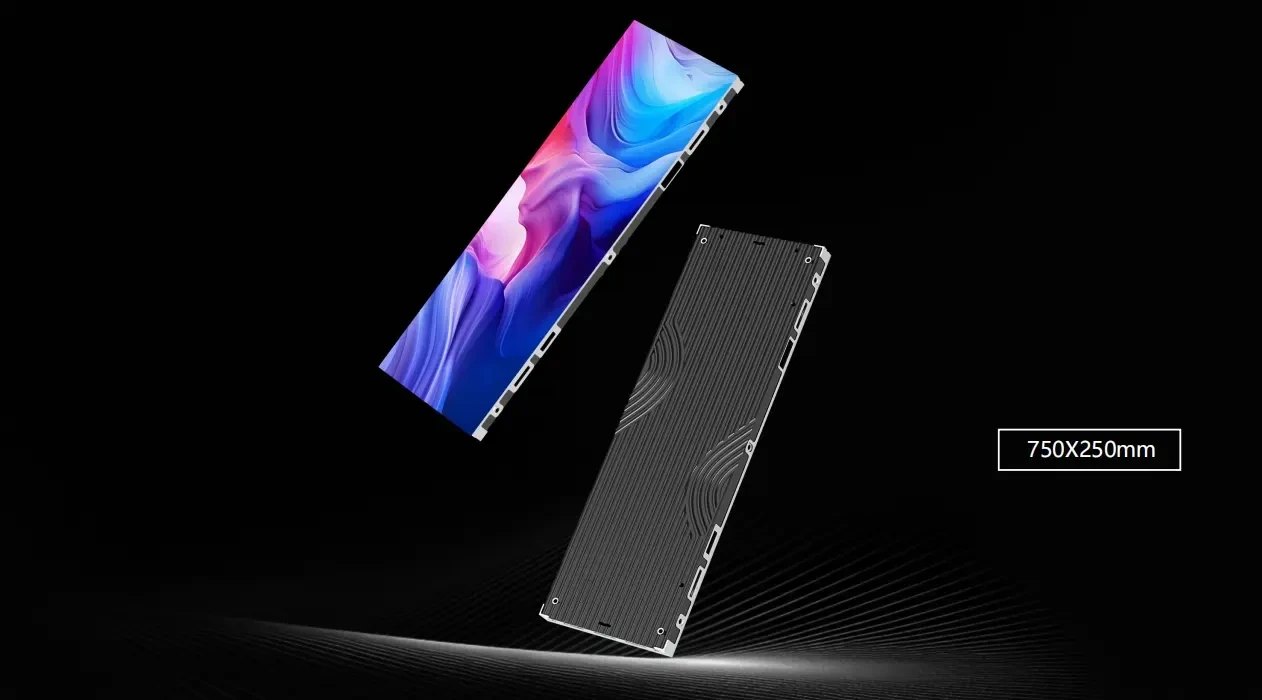
P1.95 is used where a narrow horizontal band suits the wall better than a 16:9 panel. The 750 × 250mm cabinet builds long menu boards, banner walls and entrance strips without custom cutting on site.
Every unit is assembled and tested in Shenzhen before packing. Cabinet drawings, pixel map and control-system settings are supplied with the shipment, so the configuration on site matches the quotation.
Specifications
Engineering decisions behind Indoor P1.95, and what they change on site.
Builds long horizontal bands, menu boards and banner walls from one cabinet, with portrait stacking when height is needed.
Commission the wall at the level the room needs, from dim boardrooms to glazed entrances and food-court lighting.
Modules are held magnetically and removed from the front, which suits walls finished flush to the plaster.
Indoor P1.95
Indoor P1.95 uses a 750 × 250mm die-cast aluminium cabinet with a fine-pitch module face. The cabinet is designed for permanent indoor installation where rear access is limited, so the module, receiving card and power supply are all serviceable from the front.
A machined aluminium frame holds the module plane and provides mounting points for wall brackets, floor stands or recessed frames.
The LED board, driver ICs and mask are assembled as one module. A matte surface reduces reflections from ceiling lights and windows.
Modules are held by a front-release mechanism. The receiving card and power supply sit in a pull-out cartridge behind the module, avoiding rear clearance.
Power supplies and receiving cards are distributed across the wall so a single failure affects one cabinet rather than a whole row.
Indoor P1.95 · Indoor fixed build details
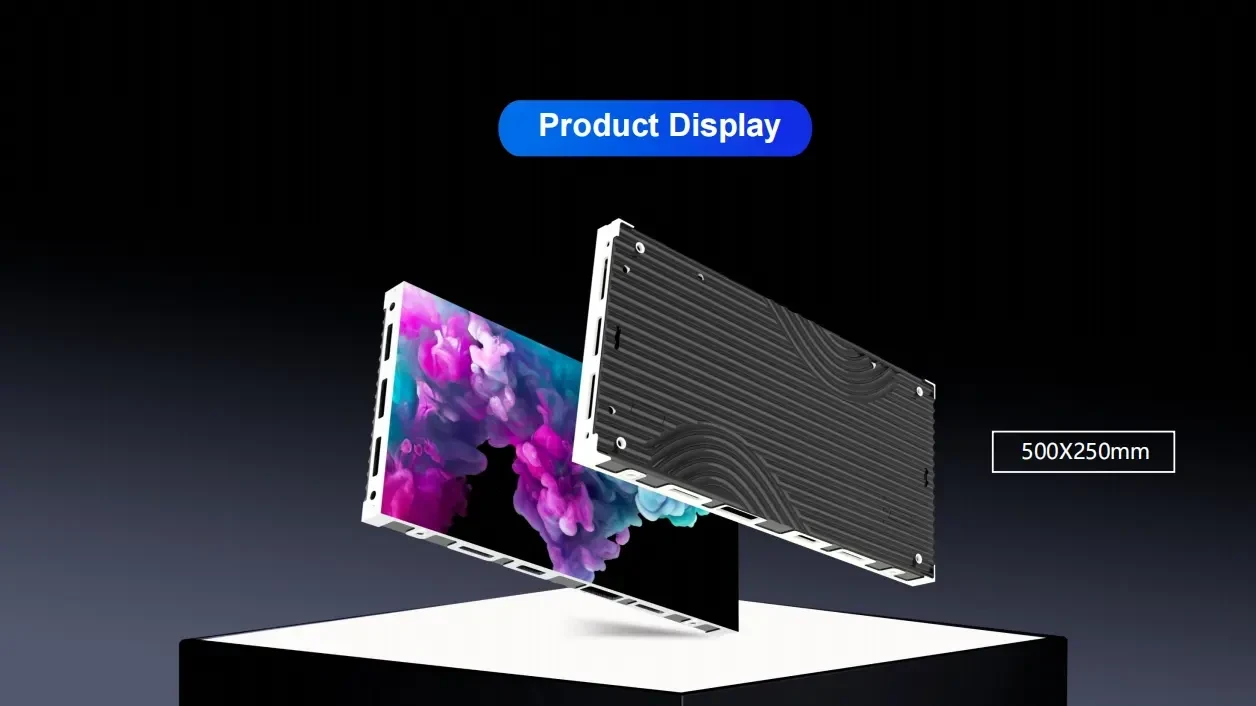
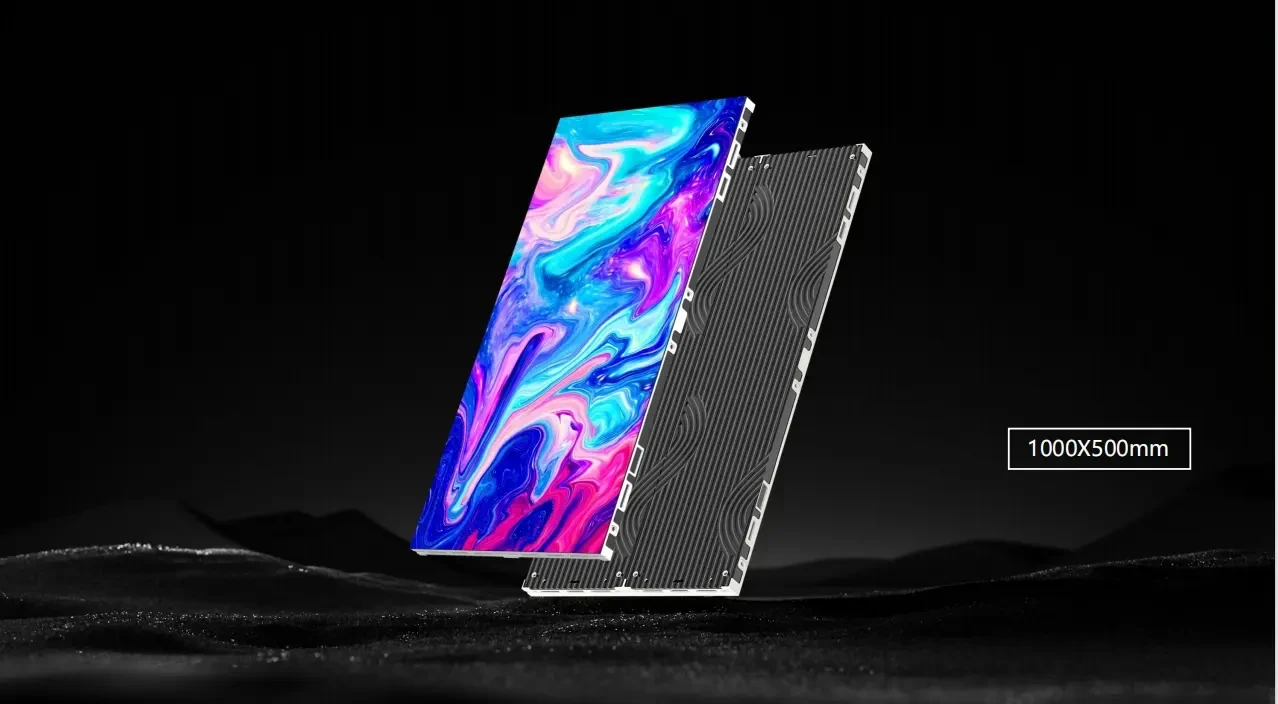
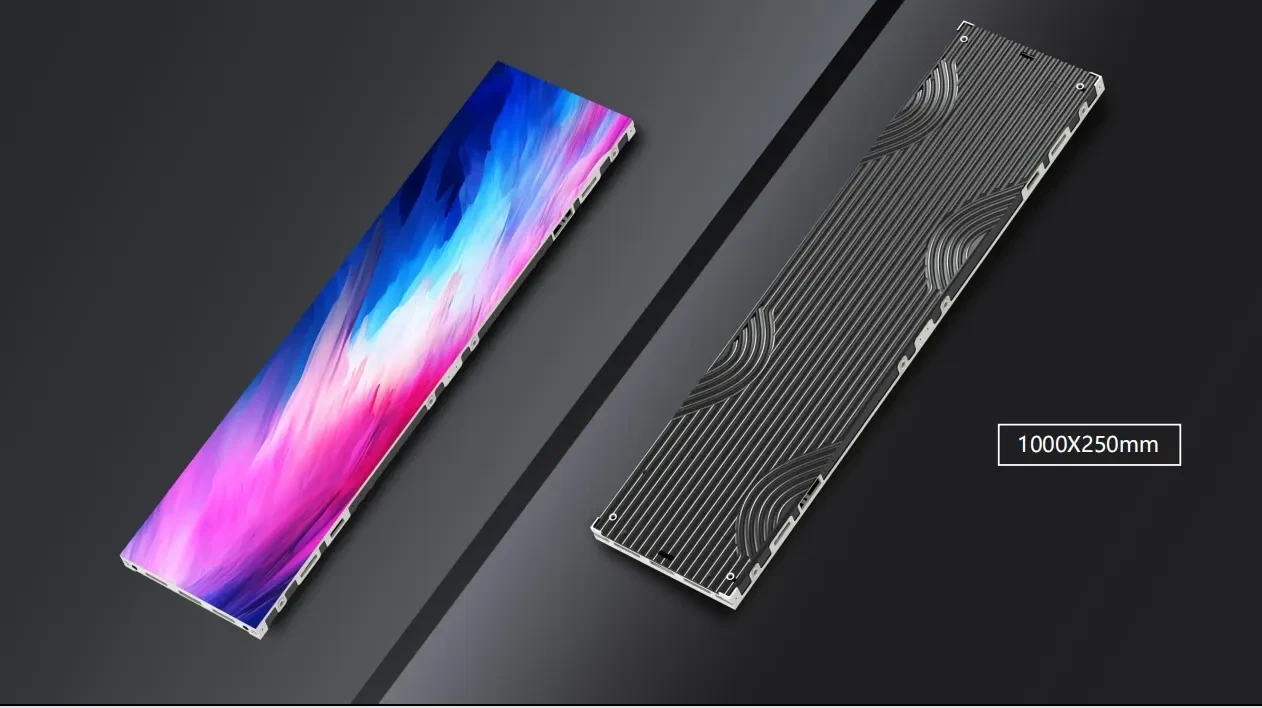
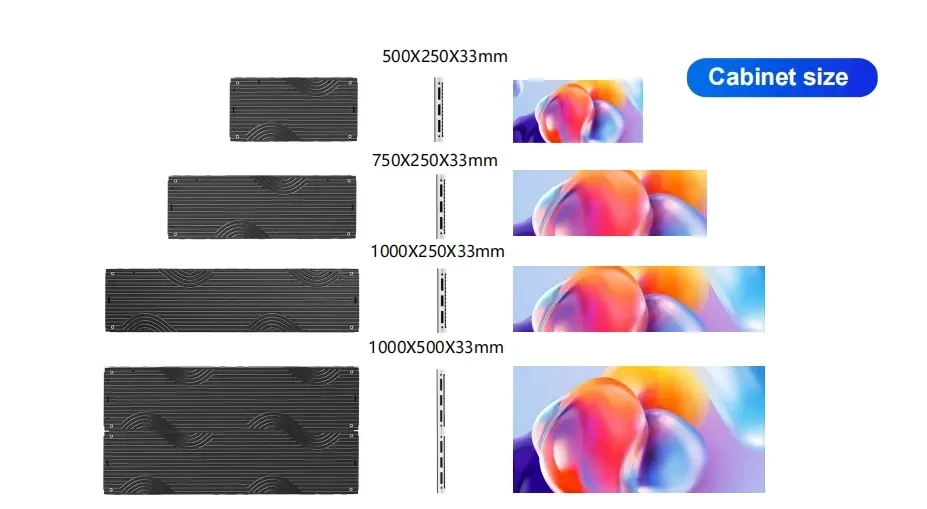
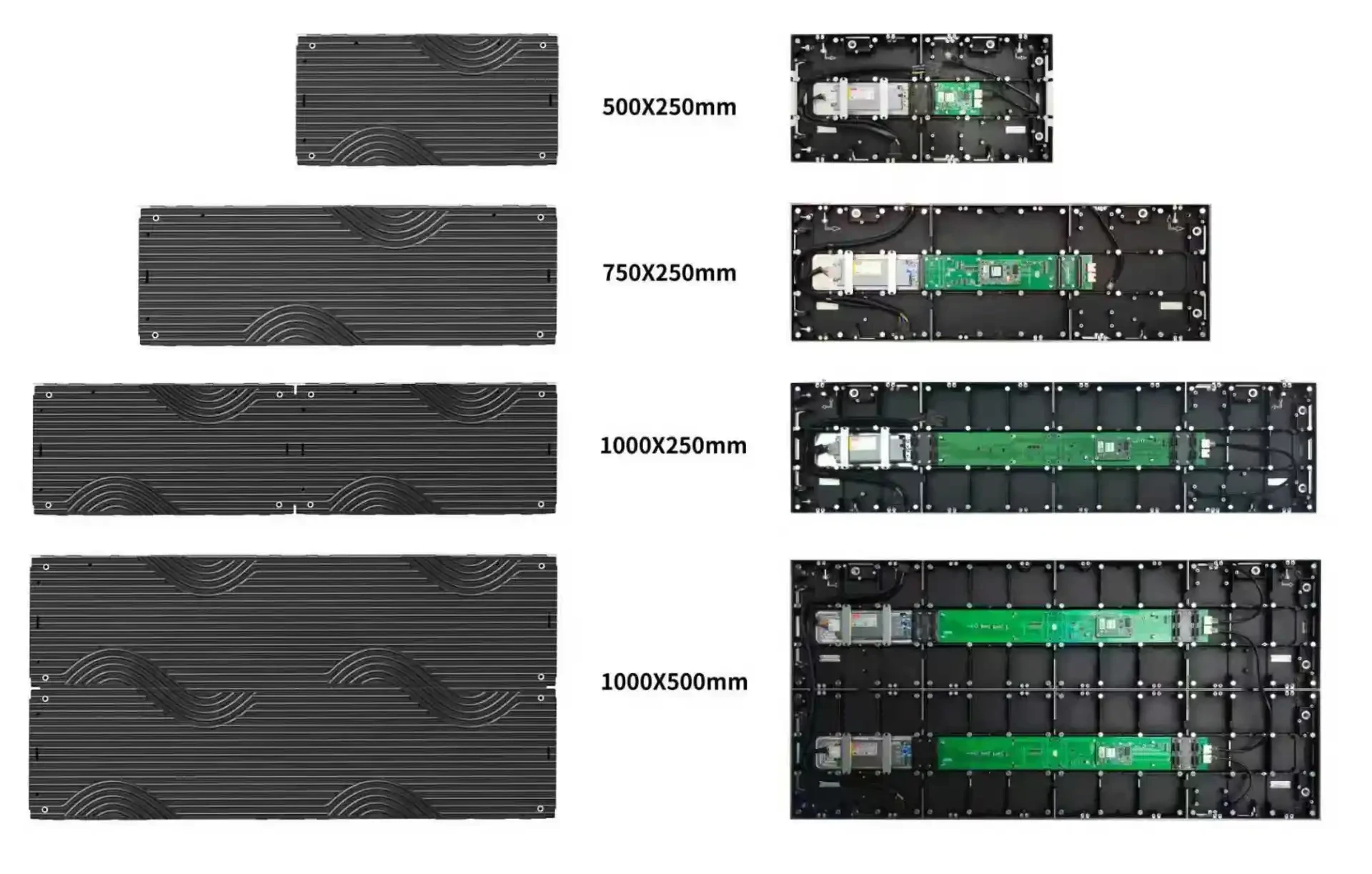
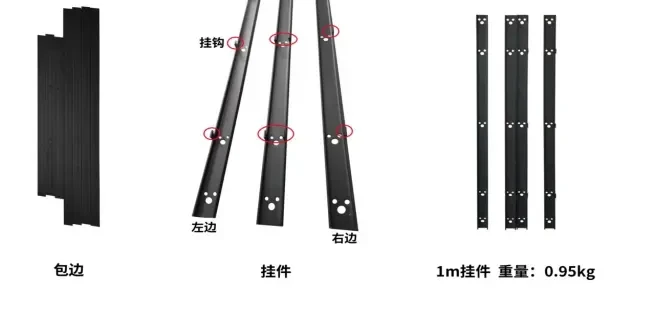
Three factory views of the indoor fixed cabinet family: the four cabinet formats, front and rear electrical layout, and the mounting hardware.
Factory cabinet and hardware views. Final module, power and mounting layout follows the approved project drawing.
 01
Cabinet formats
Four cabinet formats share a 33mm profile: 500×250, 750×250, 1000×250 and 1000×500mm, with the 500×1000mm cabinet shown landscape.
 02
Front and rear
Front and rear views show the module face, power supply, receiving card and internal wiring across the four cabinet sizes.
 03
Mounting hardware
Edge trim, left and right hanging brackets and the 1m mounting rail, listed at 0.95kg per rail.
Need the connector map, cabinet drawing or module list for a live project? Send the wall size and viewing distance.
Request detail drawingsThe decisions that affect how Indoor P1.95 looks, installs and stays serviceable on site.
The series is built around 500 × 250, 750 × 250, 500 × 1000 and 1000 × 250mm cabinets, so landscape bands, portrait columns and compact walls can be planned from standard tooling.
The module mask and black package are selected for bright lobbies. Content stays readable without turning the wall into a mirror.
Heat is spread across the cabinet back and dissipated without fans on standard models, keeping meeting rooms quiet.
Power and data enter through the cabinet frame, keeping cable trays hidden behind the wall or within the mounting recess.
Service is planned before the wall is built. Modules, cards and power supplies are replaced from the access direction agreed on the drawing.
A service tool releases the module from the front, so a wall mounted close to a wall or joinery can still be repaired without dismantling the room.
The front-service cartridge carries the receiving card and power supply. Both are replaced as field units with the wall powered down at the cabinet level.
Replacement modules are matched to the batch calibration file. Brightness and colour are checked on site before the wall is handed back.
Product credibility
Indoor P1.95 is built on the same production line as our project walls. Cabinets, modules and control settings are recorded per batch, and the documentation travels with the shipment so the site team is not working from memory.
ISO 9001
Factory process control
CE / RoHS / FCC
Product compliance
Batch tested
Aging and calibration record
2–3 years
Standard warranty
Indoor fixed selection and delivery
Indoor fixed walls are permanent, so the pitch, cabinet format and service direction must be settled before the wall is closed in. The three checks below prevent the most common rework.
P0.97–P1.25 for reception and boardroom walls viewed within 3–5 m; P1.95–P2.5 for larger halls, retail and public areas where the nearest viewer is beyond 5–6 m.
Cabinet formats of 500 × 250, 750 × 250, 500 × 1000 and 1000 × 250 mm allow landscape bands, portrait columns and compact walls. The layout should follow the finished opening and structure.
Front service is specified where the wall sits against a finished surface or joinery. Rear service can be used where a plant room or corridor provides safe access.
Model comparison
Pitch, power, cabinet and the job each model is specified for. Open a model to see its cabinet build, service access and quotation route.
| Model | Brightness | Avg power | Cabinet | Specified for | Detail |
|---|---|---|---|---|---|
Indoor P0.97 0.97mm | 600–3,500 nits | ≤220 W/m² | 500 × 250mm | Boardrooms · Corporate lobbies | View model |
Indoor P1.25 1.25mm | 600–3,500 nits | ≤220 W/m² | 500 × 1000mm | Meeting rooms · Training centres | View model |
Indoor P1.95Current 1.95mm | 600–3,500 nits | ≤260 W/m² | 750 × 250mm | Retail signage · Menu walls | Selected |
Indoor P2.5 2.5mm | 600–3,500 nits | ≤280 W/m² | 1000 × 250mm | Indoor advertising · Corridors | View model |
Typical values for the current series. Final brightness, power and cabinet detail are confirmed on the approved specification sheet.
Deployment playbook
A lobby, a boardroom and a retail wall may use the same cabinet family but need different brightness, noise and service decisions.
The wall is seen every day and photographed by visitors. A low-reflectance face, concealed cable route and clean edge detail matter as much as resolution.
P1.25–P1.95 · 600–3,500 nits · concealed cables
Presentations, video calls and spreadsheets require readable small text and quiet operation. Fanless cabinets and camera-safe refresh are preferred.
P0.97–P1.56 · low-noise · >7680Hz
Content changes frequently and the wall may be touched or cleaned. A robust module face, front service and simple content scheduling reduce downtime.
P1.95–P2.5 · front service · daily-duty build
Delivery control
A fixed wall is a construction item as much as a display. The drawing, opening dimensions and service route are agreed before production, then checked against the cabinet build.
Handover pack
Cabinet layout, control points, power distribution and the service direction are fixed before materials are cut. The approved drawing becomes the reference for every later check.
LED modules, driver ICs and power supplies are drawn from the same production batch where the order size allows, then labelled by cabinet position.
Assembled cabinets run through an aging cycle and white-balance calibration. Faults found at this stage are corrected before packing, not after arrival.
Cabinets are packed against the transport method and site access. The handover pack includes the cabinet layout, edge trim notes and the service procedure for the finished opening.
Buyer questions
These are the points that most often change the specification after the first enquiry. If your question is not here, send it with the site details.
Ask an engineerYes, when front-service modules and a front-access cartridge are specified. The service direction must be confirmed on the drawing before production, because it changes the cabinet and mounting detail.
The 500 × 1000 mm and 1000 × 250 mm cabinets can be rotated for portrait layouts, while 500 × 250 mm and 750 × 250 mm formats suit bands and compact openings. The final layout follows the finished opening.
Indoor walls can be configured from 600 to 3,500 nits. Most rooms run at the lower end; the exact setting depends on room light and content, and the wall is commissioned at a level that keeps text readable without glare.
Yes. A small spare set matched to the production batch keeps colour consistency and reduces downtime. The recommended quantity is stated with the quotation.
Next step
Use the conference guide and project references to confirm viewing distance, cabinet format and service access.
See how this series is specified against viewing distance, room light and installation constraints.
Open application guideReview project types, cabinet formats and the delivery scope used on comparable installations.
View case studiesRequest the current specification sheet, cabinet drawing and control compatibility list.
Open downloadsSend the wall size, viewing distance and site photos. We reply with a configuration and quotation.
Request a quoteSend viewing distance, wall size and installation type. We reply with cabinet quantity, control layout and a quotation within 24 business hours.